
A featured contribution from Leadership Perspectives: a curated forum reserved for leaders nominated by our subscribers and vetted by the Construction Tech Review Advisory Board.

Mazda Motor Europe
Model-based Development in the Automotive Industry
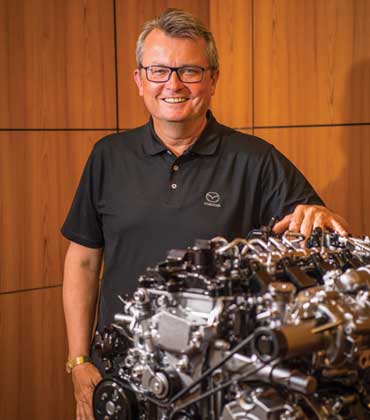
The automotive industry is undergoing a major transformation. This transformation, which is said to change mobility fundamentally, is mainly driven by new trends and regulations in the four CASE areas: connected, automated, shared and electric mobility. In order to manage this transformation successfully, manufacturers must increase their R&D efforts fundamentally. Model-Based Development (MBD) has proven to be an efficient method to optimise the development of increasingly complex systems efficiently.
MBD uses advanced computer simulations to efficiently replicate development processes, e.g. in the power train and vehicle development. Along its technology and vehicle development chain, Mazda identified 700 functions where digital modelling can be used. Over time, engineers increased the modelling rate step by step and are now able to realise a majority of development processes digitally. The results are significant improvements in productivity and product quality.
Besides enhancements to existing technology, MBD has proven to be an indispensable method when it comes to the development and optimisation of completely new technology concepts. Mazda’s proprietary Skyactiv Technology, developed in the aftermath of the global financial crisis when the automotive industry was widely devastated, was the first project where MBD enabled engineers to achieve a breakthrough.
Digital simulation was long considered of limited value for the optimisation of the combustion process as a correlation between simulation, and real-world performance was difficult to reach. We conducted a performance test under high compression ratio which no one had ever tried before. The result was a certain level of deterioration of performance, however, we saw a possibility of recovery and decided to continue development work on this technology.
Running extensive simulations with varying parameters at first showed that the negative effect of higher compression ratios was lower than expected. Further optimisation of the simulation model itself and adjustments to the parameters finally led to the desired breakthrough. Using the common architecture principle, the findings were then used to homogenise combustion characteristics and apply them to different displacements. Today the Mazda Skyactiv-G engine with a 14:1 compression ratio is powering millions of cars on roads worldwide.
Digital simulation was long considered of limited value for the optimisation of the combustion process as a correlation between simulation, and real-world performance was difficult to reach
However, with regulation becoming more severe and new trends arising on the market, we also see technology becoming more complex. A recent example is the development of Mazda’s Skyactiv-X engine technology, which has been launched in Europe this year. To achieve outstanding environmental performance and fuel efficiency in an internal combustion engine, Mazda developed a completely new combustion process called Spark Controlled Compression Ignition (SPCCI). This process allows the engine to switch seamlessly between conventional combustion and compression ignition by using a spark to trigger both types of combustion in different ways. Complex combustion processes like this require highly advanced capabilities in computer-aided development. Without the use of MBD, requiring highly accurate analysis and significantly increase supercomputing capabilities, the development of the Skyactiv-X technology up to mass-production level could not have been realised.
Taking connected and automated driving as an example, new mobility solutions will become more and more complex, and therefore the R&D efforts required by manufacturers will continue to increase. Mazda is, therefore, working together with academia and other OEMs to further improve digital modelling, reduce deviations and also train engineers using the software. As technology becomes more and more complex, there is a significant potential for MBD to be further developed and play an important role in shaping the mobility of the future.

